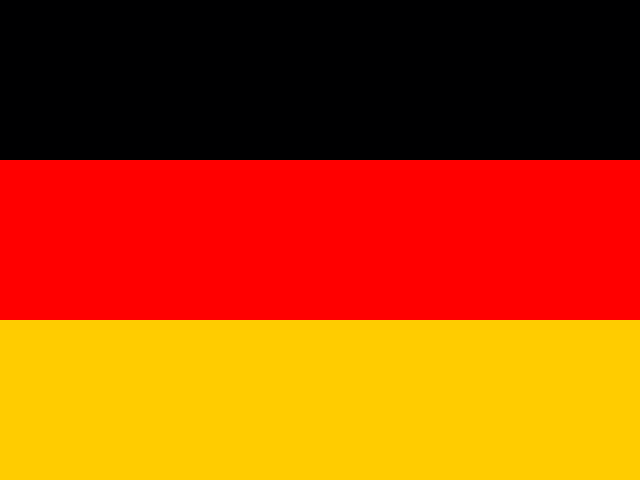
Germany lies in Western Europe, part of Europe. In formal use it is Federal Republic of Germany. Berlin is the capital.
Around 83.5 million people live there, placing it 19th of 250 by population — between Türkiye above it and Thailand below. Within Western Europe alone it is the 2nd largest of 8 and the 1st most populous.
By land area it covers 357,114 km², which ranks it 64th of the 250 countries and territories in this dataset — just behind Japan and just ahead of the Philippines. That makes it a little larger than the Philippines.
Where Germany is and what surrounds it
Its reference point sits at 51.0° north and 9.0° east, which puts it in the northern hemisphere, roughly 5,677 km from the equator, in what geographers would call temperate latitudes.
It borders 9 neighbours: Austria, Belgium, Czechia, Denmark, France, Luxembourg, the Netherlands, Poland and Switzerland. The largest of them by area is France, which is also the most populous. Together those neighbours hold about 170.7 million people.
Unlike its landlocked neighbours it reaches the sea directly, while also sharing land frontiers.
Map data © OpenStreetMap contributors
Population, density and language
Spread across 357,114 km², that works out at about 234 people per square kilometre, which makes it densely populated. The median across all 250 entries here is about 90 per square kilometre.
The demonym is German, so residents are Germans.
The one official language is German. It shares that with Belgium, Liechtenstein, Luxembourg and Namibia.
Inside Europe it places 2nd of 53 by population, and it accounts for 44% of everyone living in Western Europe.
Currency, domain and dialling code
The currency is the Euro (€, EUR). That is a shared currency: 37 other entries use it, including Andorra, Austria, Belgium, Bulgaria and Croatia.
Berlin is the seat of government and the answer most quizzes are looking for.
Its internet country code is .de. The international dialling code is +49. In ISO terms it is de in two letters and DEU in three.
As a sovereign state it is among the 193 UN members listed here. The other 57 entries are territories, dependencies or observers, which is why totals on this site run to 250 rather than the familiar 195.
Neighbouring countries
Germany shares borders with 9 countries:
Fun facts about Germany
- Ranked by land area, Germany is 64th out of the 250 countries and territories on this site.
- It is 19th of 250 by population, with about 83.5 million residents.
- It lies about 5,677 km from the equator, in temperate latitudes.
- Its full official name is Federal Republic of Germany.
- In land area it is a little larger than the Philippines.
- Its capital city is Berlin.
- Population density works out at roughly 234 people per square kilometre.
- Websites based there use the .de domain.
Germany — frequently asked questions
- What is the capital of Germany?
- The capital of Germany is Berlin.
- What currency does Germany use?
- Germany uses the Euro, written € (currency code EUR). It is shared with 37 other entries.
- How big is Germany?
- Germany covers 357,114 km², ranking 64th of 250 by land area. That makes it a little larger than the Philippines.
- What is the population of Germany?
- Germany has a population of about 83.5 million, which makes it the 19th most populous of the 250 countries and territories listed on this site. Türkiye sits just above it and Thailand just below.
- Is Germany a country?
- Yes. Germany is a sovereign state and one of the 193 UN members listed on this site.
- Which countries border Germany?
- Germany borders 9 countries: Austria, Belgium, Czechia, Denmark, France, Luxembourg, the Netherlands, Poland and Switzerland. France is the largest of them by area.
- Where is Germany located?
- Germany is in Western Europe, part of Europe. Its reference coordinates are 51.0° north and 9.0° east, roughly 5,677 km from the equator in temperate latitudes.
- What language is spoken in Germany?
- The official language of Germany is German. It is also official in 4 other entries on this list.