Countries in Antarctic
5 Antarctic and sub-Antarctic territories, 14,012,111 km² of ice and rock, and roughly 1,330 people — none of them permanent residents. Spin the wheel to pick one, or read the list below.
5 countries are on the wheel right now.
Press Spin and the pointer decides where you are going.
Every wedge has an equal chance. Nothing is weighted and nothing is remembered between spins.
Antarctic at a glance
5
Countries & territories
0
Sovereign states
1,330
Total population
0.0%
Share of world population
14,012,111 km²
Combined land area
0
Landlocked
5
No land border
3
Official languages
All countries in Antarctic (A–Z)
Every entry below opens a full guide with the capital, population, land area, languages, currency, neighbouring countries and a map. 0 of these 5 are sovereign states; the rest are territories, dependencies and overseas regions.
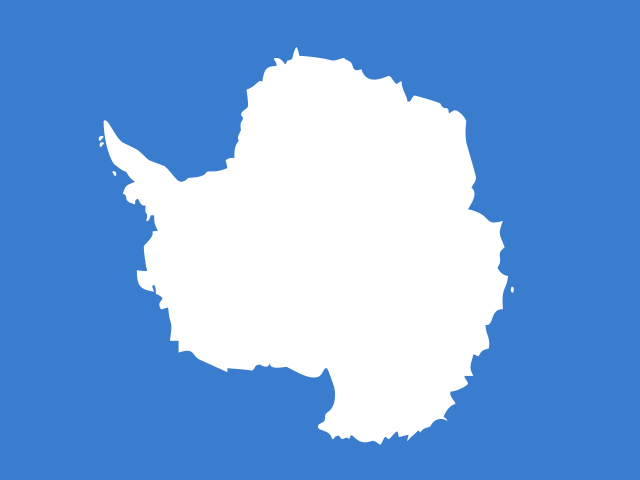


The one region with no countries in it
Every other region on this site is a list of countries. This one is not. The Antarctic contains 5 entries and 0 sovereign states, because no country owns Antarctica and, under the treaty that governs it, none can. What exists instead are territorial claims that other nations decline to recognise, a scattering of sub-Antarctic islands administered from far away, and a population of scientists who rotate home every year.
The Antarctic Treaty, signed in 1959 by twelve nations and now backed by more than fifty, froze all territorial claims, banned military activity and mineral extraction, and set the continent aside for science. Seven countries — Argentina, Australia, Chile, France, New Zealand, Norway and the United Kingdom — maintain claims, three of which overlap on the Antarctic Peninsula. None of the claims has any practical effect while the treaty holds, which is the point of it.
The population figure of roughly 1,330 on this page counts research station staff, not residents. It swings by a factor of four between the southern summer, when supply ships and flights can reach the coast, and the winter, when a skeleton crew of a few hundred is sealed in for six months. 2 of the 5 entries have no people at all, and three have no capital because there is nothing there to be a capital of.
The five entries, one by one
Largest by area
🇦🇶 Antarctica
14,000,000 km²
Smallest by area
🇧🇻 Bouvet Island
49 km²
Most populous
🇦🇶 Antarctica
1,000
Fewest people
🇬🇸 South Georgia
30
Antarctica itself is 14,000,000 km², nearly twice the size of Australia and about half again the size of the United States, and it holds roughly ninety per cent of the world's ice. French Southern and Antarctic Lands comes second at 7,747 km² of land — a French administrative grouping covering the Kerguelen Islands, Crozet, Amsterdam and Saint-Paul, plus a claimed wedge of the continent called Adélie Land.
South Georgia and the South Sandwich Islands, 3,903 km², is a British territory best known as the end point of Shackleton's open-boat journey in 1916 and the site of his grave at Grytviken. Heard Island and McDonald Islands, an Australian territory, contains Big Ben, an active volcano and the highest point on any Australian territory. Bouvet Island, at 49 km², is a Norwegian dependency generally described as the most remote island on Earth — the nearest land of any kind is over 1,600 km away.
Who governs the Antarctic
Antarctic
51,330 people across 5 entries.
There is no government, no capital and no citizenship. Decisions are taken at the Antarctic Treaty Consultative Meeting, held annually, where the twenty-nine consultative parties vote by consensus. That structure has held since 1961 without a single armed dispute, which makes it one of the more successful pieces of international law of the last century, and one of the least discussed.
The Madrid Protocol of 1991 added the important clause: mining and mineral extraction are prohibited south of 60°S, and the ban runs until at least 2048. Fishing in the Southern Ocean is managed separately under CCAMLR, which is where most of the genuine political friction now sits — krill quotas matter far more to the region's future than any of the paper territorial claims do.
Languages, money and daily life
Most widespread official languages
- Englishofficial in 2 places
- Frenchofficial in 1 place
- Norwegianofficial in 1 place
3 distinct official languages recorded across Antarctic.
Most widely used currencies
- Euro (EUR)1 place
- Saint Helena pound (SHP)1 place
2 distinct currencies in circulation across Antarctic.
3 languages appear as official across these 5 entries: English in 2, French in 1 and Norwegian in 1. In practice far more are spoken, because research stations belong to more than thirty nations and a season at McMurdo, Vostok or Concordia is a genuinely multilingual affair.
Currency is largely theoretical. The French territories use the euro and South Georgia nominally uses the pound, but there are no shops to speak of, no permanent economy, and most transactions on the continent are internal to national research programmes. What money does move through the region comes from tourism — roughly a hundred thousand visitors a year arrive by ship at the Peninsula — and from fishing licences in sub-Antarctic waters.
Compare Antarctic with the rest of the world
Every region has its own page built the same way, so the figures line up and you can put them side by side. The count beside each name is how many countries and territories it holds.
If you would rather not pick a region at all, the global country wheel carries all 250 entries on the site, and the full A–Z index lets you search rather than spin. The continents overview compares all six regions on one screen.
Once you know the map, test it. The capital city quiz can be filtered by region, guess the flag strips out the country names entirely, and the landlocked countries page covers the 0entries here with no coastline alongside the rest of the world's. There are longer write-ups on the blog if you want the background behind the numbers.
Antarctic: frequently asked questions
How many countries are there in Antarctica?
None. Antarctica has no sovereign countries and no permanent population, and the Antarctic Treaty of 1959 prevents any nation from asserting ownership. This page lists 5 entries, all of them territories, claims or sub-Antarctic island groups administered by other countries. It is the only region on this site with 0 sovereign states in it.
Who owns Antarctica?
Nobody. Seven countries — Argentina, Australia, Chile, France, New Zealand, Norway and the United Kingdom — maintain territorial claims, and the Argentine, Chilean and British claims overlap on the Antarctic Peninsula. All claims are held in abeyance by the Antarctic Treaty, which more than fifty nations have now signed. The United States and Russia recognise no claims and reserve the right to make their own.
How many people live in Antarctica?
The figure on this page is roughly 1,330 across all 5 entries, and none of them are permanent residents. Around 4,000 to 5,000 researchers and support staff are present across the continent in the southern summer, dropping to about 1,000 in winter. Everyone leaves eventually; there is no citizenship, no economy and no reason to stay.
What is the largest Antarctic territory?
Antarctica itself, at 14,000,000 km², which is nearly twice the size of Australia and holds about ninety per cent of the world's ice and roughly seventy per cent of its fresh water. Of the sub-Antarctic groups, the French Southern and Antarctic Lands are the largest at 7,747 km².
What is the most remote island in the world?
Bouvet Island, a Norwegian dependency of 49 km² in the South Atlantic, is usually given the title. It is uninhabited, almost entirely covered by a glacier, and the nearest land is more than 1,600 km away. It also holds the world's least-used internet domain, .bv, which has never had a registered site.
Can you visit the Antarctic region?
Yes, though only in the southern summer and almost always by ship. Around a hundred thousand tourists a year reach the Antarctic Peninsula, most of them on expedition cruises out of Ushuaia in Argentina. South Georgia is a common stop on the same routes. Heard Island and Bouvet Island are effectively off-limits, requiring permits and a serious expedition vessel.
How is the random country wheel on this page different from the main one?
This wheel is loaded only with countries from this region, so every spin lands inside it. The wheel on the main spin page carries all 250 countries and territories on the site. Use the regional wheel when you are studying one part of the world and the global one when you want a genuine surprise.
Where do these population and area figures come from?
They come from the same dataset that powers every country guide on this site, built on public country data and the most recent published estimates for population and land area. Population figures in particular are estimates and move constantly, so treat them as accurate to within a percent or two rather than to the last person.
Why does this page count territories as well as countries?
Because they are real places with flags, capitals and residents, and leaving them out would hide some of the most interesting entries on the map. Every guide states plainly whether a place is a sovereign state or a territory, and the sovereign count is given separately in the statistics above so you can use whichever number you need.
Can I use these figures in a school project?
Yes, and it is worth citing the date you looked them up, because population estimates change. If your project needs one authoritative source, cross-check the headline numbers against the UN World Population Prospects or the country's own statistics office. The rankings here — largest, smallest, most populous — are stable and safe to quote.