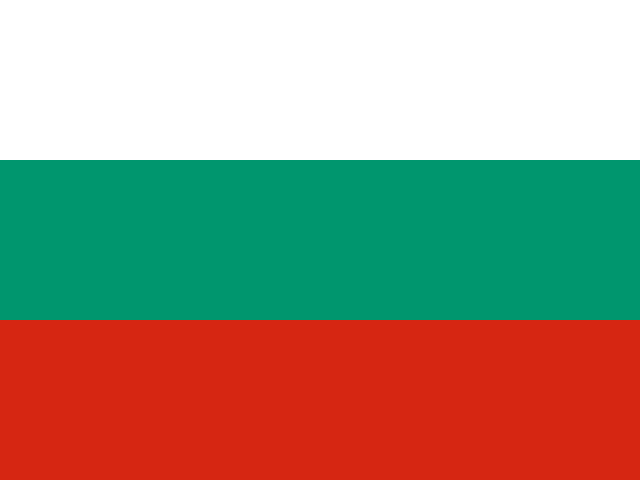
Bulgaria overview
Bulgaria is a sovereign country in Southeast Europe, in the wider region of Europe. The long form of the name is Republic of Bulgaria. Sofia is the capital.
Around 6.4 million people live there, placing it 111th of 250 by population — between Serbia above it and El Salvador below. Among the 9 entries in Southeast Europe it ranks 2nd by area and 3rd by population.
By land area it covers 110,879 km², which ranks it 106th of the 250 countries and territories in this dataset — just behind Liberia and just ahead of Cuba. For scale, it is a little larger than Iceland.
Bulgaria and its neighbours, side by side
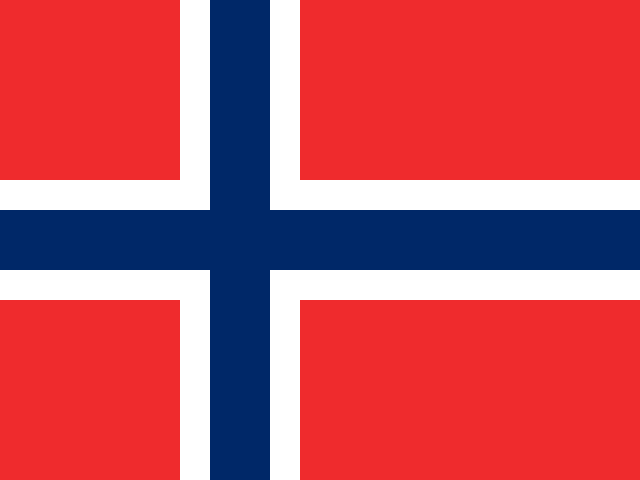
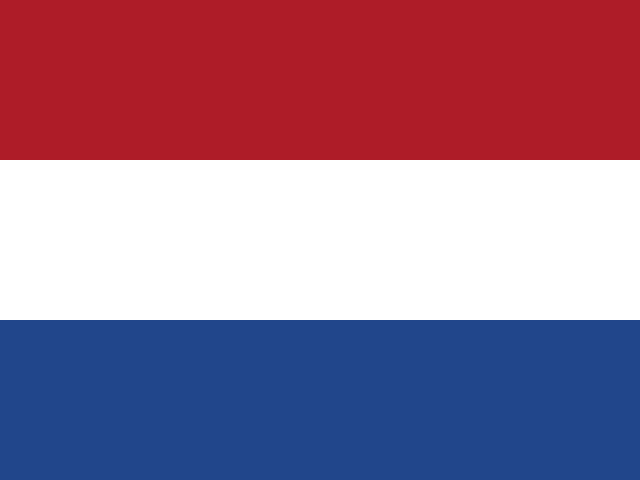
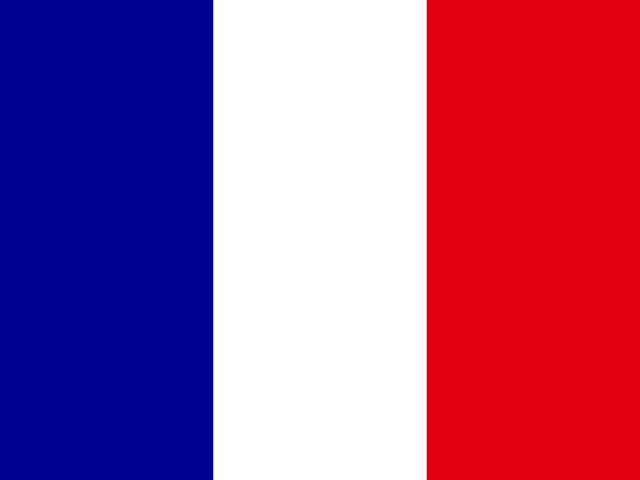
Bulgaria has 5 land neighbours, and together they hold 123,386,434 people — about 19 times Bulgaria's own population. Sharing a frontier with that much weight on the other side shapes trade, migration and language in ways the map alone does not show.
| Neighbour | Population | Area (km²) | vs Bulgaria by area |
|---|---|---|---|
| Türkiye | 85,518,661 | 783,562 | 7.1× larger |
| Romania | 19,051,804 | 238,391 | 2.2× larger |
| Greece | 10,405,134 | 131,990 | 1.2× larger |
| Serbialandlocked | 6,586,476 | 88,361 | 1.3× smaller |
| North Macedonialandlocked | 1,824,359 | 25,713 | 4.3× smaller |
By area the largest neighbour is Türkiye and the smallest is North Macedonia; by population Türkiye is the heaviest presence on the border. Taken together the neighbours hold more people than Bulgaria does, which is the usual situation for a country with several borders and rarely a comfortable one.
Bulgaria at a glance
- Capital
- Sofia
- Population
- 6,441,421
- Area
- 110,879 km²
- Region
- Southeast Europe, Europe
- Languages
- Bulgarian
- Currency
- Euro (EUR)
- Calling code
- +359
- Internet TLD
- .bg
- People per km²
- 58
Where Bulgaria is and what surrounds it
The coordinates the dataset gives are 43.0° N, 25.0° E, which puts it in the northern hemisphere, roughly 4,787 km from the equator, in what geographers would call temperate latitudes.
Uzbekistan and Kyrgyzstan sit at almost exactly the same latitude on other parts of the globe.
Its land neighbours number 5: Greece, North Macedonia, Romania, Serbia and Türkiye. The largest of them by area is Türkiye, which is also the most populous. Together those neighbours hold about 123.4 million people.
Unlike its landlocked neighbours it reaches the sea directly, while also sharing land frontiers.
Where Bulgaria is on the map
The map below is centred on Bulgaria at roughly 43.00°, 25.00°. Pan and zoom to see how it sits against its surroundings — the shape of a country's borders explains a surprising amount about its history.
Map data © OpenStreetMap contributors
People, population and language
Population divided by land area gives roughly 58 people per square kilometre, which makes it less crowded than the typical entry on this list. For comparison, the median entry on this list sits near 90 per square kilometre.
Bulgarian is the only official language. No other entry in this dataset lists Bulgarian, so on this list it stands alone.
People from Bulgaria are called Bulgarians.
Inside Europe it places 21st of 53 by population, and it accounts for 14% of everyone living in Southeast Europe.
Bulgaria within Southeast Europe
Zoom in from the world to Southeast Europe and Bulgaria sits 3rd of 9 by population and 2nd by area. Its immediate company in that ordering is Serbia just above and Croatia just below, which is a more honest comparison set than a global league table.
Romania is the largest of the group by population, and every entry in Southeast Europe has its own page here if you want to work through the whole neighbourhood rather than one country at a time.
Money and language in Bulgaria
Bulgaria does not have the Euro to itself. It is one of 38 entries on this site that use the currency, whose code is EUR, and the others include listed below. A shared currency usually points at something real — a monetary union, a currency board, a former colonial administration, or a small economy pegging itself to a large neighbour's money — and it means a price quoted in EUR travels further than you might expect.
Bulgarian is listed for Bulgaria and for no other entry on this site. A language confined to one country is unusual, and it is normally a sign of long isolation or of deliberate revival.
How big is Bulgaria, really?
Put next to every other entry on this site, Bulgaria ranks 106th of 250 by area and 111th by population. That works out at 0.074% of the combined land area of all 250 entries and 0.079% of their combined population. Those denominators matter: this list includes territories and dependencies as well as UN member states, so a rank here is not the same as a rank among sovereign countries.
For a sense of scale, the entries immediately either side of Bulgaria in the size ordering are Liberia at 111,369 km² and Cuba at 109,884 km², against Bulgaria's 110,879 km². If you can already picture one of those, you can picture this one.
Density tells a different story from either raw figure. Bulgaria averages 58 people per square kilometre of total area, which makes it middling in density — 160th of the 248 entries that have both a population and a measured area. Total area includes inland water, so the true figure for habitable land is higher than this.
Money, internet and phone codes
It uses the Euro (€, EUR). That is a shared currency: 37 other entries use it, including Andorra, Austria, Belgium, Croatia and Cyprus.
The top-level domain is .bg. Calls from overseas start with +359. Its ISO codes are bg and BGR, which is what most databases and flag files use.
Sofia is the seat of government and the answer most quizzes are looking for.
It holds a seat at the United Nations, one of 193 entries here that do. The other 57 entries are territories, dependencies or observers, which is why totals on this site run to 250 rather than the familiar 195.
Fun facts about Bulgaria
- It lies about 4,787 km from the equator, in temperate latitudes.
- It is 111th of 250 by population, with about 6.4 million residents.
- Population density works out at roughly 58 people per square kilometre.
- Within Southeast Europe it is the 2nd largest of 9.
- People from Bulgaria are known as Bulgarians.
- It shares land borders with 5 countries: Greece, North Macedonia, Romania, Serbia and Türkiye.
- Uzbekistan and Kyrgyzstan sit at almost the same latitude, on the far side of the globe.
Bulgaria — frequently asked questions
- What is the capital of Bulgaria?
- The capital of Bulgaria is Sofia.
- What currency does Bulgaria use?
- Bulgaria uses the Euro, written € (currency code EUR). It is shared with 37 other entries.
- How big is Bulgaria?
- Bulgaria covers 110,879 km², ranking 106th of 250 by land area. That makes it a little larger than Iceland.
- Where is Bulgaria located?
- Bulgaria is in Southeast Europe, part of Europe. Its reference coordinates are 43.0° north and 25.0° east, roughly 4,787 km from the equator in temperate latitudes.
- Is Bulgaria a country?
- Yes. Bulgaria is a sovereign state and one of the 193 UN members listed on this site.
- Which countries border Bulgaria?
- Bulgaria borders 5 countries: Greece, North Macedonia, Romania, Serbia and Türkiye. Türkiye is the largest of them by area.
- What language is spoken in Bulgaria?
- The official language of Bulgaria is Bulgarian. No other entry on this list gives it official status.
- What is the population of Bulgaria?
- Bulgaria has a population of about 6.4 million, which makes it the 111th most populous of the 250 countries and territories listed on this site. Serbia sits just above it and El Salvador just below.