North Macedonia overview
Filed under Europe and more precisely Southeast Europe, North Macedonia is a sovereign state. The long form of the name is Republic of North Macedonia. The capital is Skopje.
Its territory runs to 25,713 km², which ranks it 151st of the 250 countries and territories in this dataset — just behind Rwanda and just ahead of Djibouti. That makes it around a fifth smaller than Belgium.
Some 1.8 million people call it home, placing it 152nd of 250 by population — between Latvia above it and Kosovo below. Within Southeast Europe alone it is the 7th largest of 9 and the 7th most populous.
How North Macedonia reaches the sea
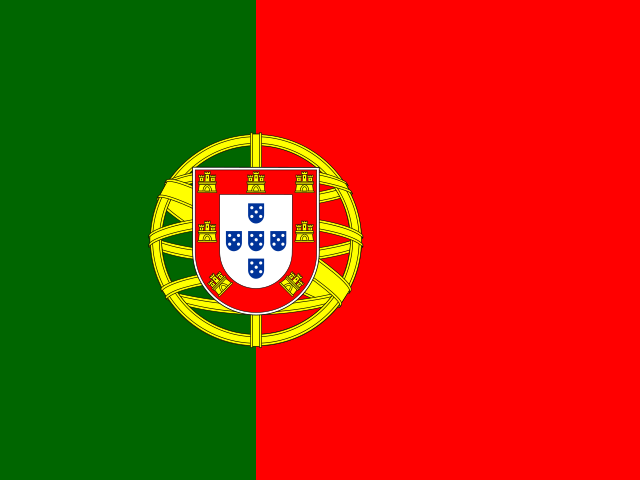
North Macedonia has no coastline of its own, so every ship-borne import and export crosses somebody else's border first. The good news is that the sea is only one frontier away: Greece, Bulgaria and Albania have coastline, which makes them the obvious routes for freight heading to a port.
That geography has practical consequences. Landlocked countries carry higher freight costs than coastal ones because goods change hands, transport mode and jurisdiction more often, and because a neighbour's road, rail or customs problem becomes North Macedonia's problem too. It is also why transit agreements with bordering states, and access to their ports, tend to matter more in North Macedonia's foreign policy than the distance on a map would suggest.
Of the countries on North Macedonia's borders, Kosovo and Serbia are landlocked as well, so a route in that direction only moves the problem along. The remaining borders are the ones that lead, eventually, to salt water.
Coastal countries on the border:
North Macedonia and its neighbours, side by side
North Macedonia has 5 land neighbours, and together they hold 27,570,159 people — about 15 times North Macedonia's own population. Sharing a frontier with that much weight on the other side shapes trade, migration and language in ways the map alone does not show.
| Neighbour | Population | Area (km²) | vs North Macedonia by area |
|---|---|---|---|
| Greece | 10,405,134 | 131,990 | 5.1× larger |
| Bulgaria | 6,441,421 | 110,879 | 4.3× larger |
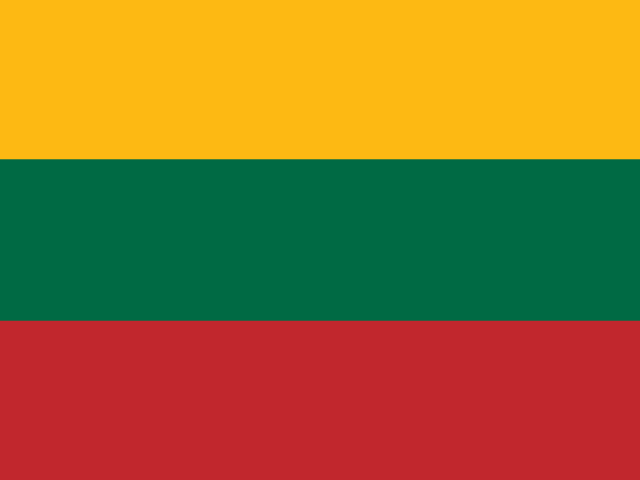
| Serbialandlocked | 6,586,476 | 88,361 | 3.4× larger |
| Albania | 2,377,128 | 28,748 | 1.1× larger |
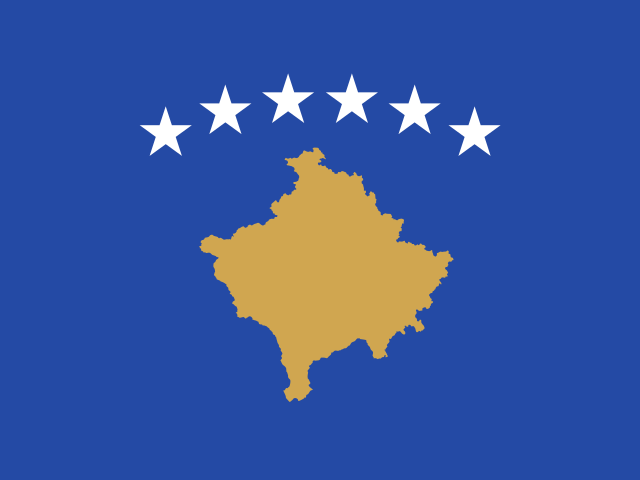
| Kosovolandlocked | 1,760,000 | 10,908 | 2.4× smaller |
By area the largest neighbour is Greece and the smallest is Kosovo; by population Greece is the heaviest presence on the border. Taken together the neighbours hold more people than North Macedonia does, which is the usual situation for a country with several borders and rarely a comfortable one.
North Macedonia at a glance
- Capital
- Skopje
- Population
- 1,824,359
- Area
- 25,713 km²
- Region
- Southeast Europe, Europe
- Languages
- Macedonian
- Currency
- denar (MKD)
- Calling code
- +389
- Internet TLD
- .mk
- People per km²
- 71
Location, borders and position
Its reference point sits at 41.8° north and 22.0° east, which puts it in the northern hemisphere, roughly 4,657 km from the equator, in what geographers would call temperate latitudes.
Countries on the same parallel, far away in longitude, include Turkmenistan, Uzbekistan and Kyrgyzstan.
It borders 5 neighbours: Albania, Bulgaria, Greece, Kosovo and Serbia. The largest of them by area is Greece, which is also the most populous. Together those neighbours hold about 27.6 million people.
It has no sea coast of its own. That is true of 45 of the 250 entries here, and it means every shipment in or out has to cross someone else's border first. 2 of its neighbours, Kosovo and Serbia, are landlocked too. You can see the full picture on the landlocked countries page.
Where North Macedonia is on the map
The map below is centred on North Macedonia at roughly 41.83°, 22.00°. Pan and zoom to see how it sits against its surroundings — the shape of a country's borders explains a surprising amount about its history.
Map data © OpenStreetMap contributors
People, population and language
Population divided by land area gives roughly 71 people per square kilometre, which makes it less crowded than the typical entry on this list. The median across all 250 entries here is about 90 per square kilometre.
Officially it is monolingual: Macedonian. No other entry in this dataset lists Macedonian, so on this list it stands alone.
Someone from North Macedonia is a Macedonian.
Inside Europe it places 34th of 53 by population, and it accounts for 4.0% of everyone living in Southeast Europe.
North Macedonia within Southeast Europe
Zoom in from the world to Southeast Europe and North Macedonia sits 7th of 9 by population and 7th by area. Its immediate company in that ordering is Albania just above and Kosovo just below, which is a more honest comparison set than a global league table.
Romania is the largest of the group by population, and every entry in Southeast Europe has its own page here if you want to work through the whole neighbourhood rather than one country at a time.
Currency and codes
The currency is the denar (den, MKD). It shares that currency with.
Skopje is the city to remember for this country.
Its internet country code is .mk. Calls from overseas start with +389. Standard country codes: mk and MKD.
It holds a seat at the United Nations, one of 193 entries here that do. The other 57 entries are territories, dependencies or observers, which is why totals on this site run to 250 rather than the familiar 195.
Money and language in North Macedonia
The denar (MKD) is used only in North Macedonia among the 250 entries on this site. Its own currency is one of the clearest markers of an economy that sets its own monetary policy rather than importing somebody else's.
Macedonian is listed for North Macedonia and for no other entry on this site. A language confined to one country is unusual, and it is normally a sign of long isolation or of deliberate revival.
Fun facts about North Macedonia
- Ranked by land area, North Macedonia is 151st out of the 250 countries and territories on this site.
- In land area it is around a fifth smaller than Belgium.
- Population density works out at roughly 71 people per square kilometre.
- People from North Macedonia are known as Macedonians.
- Its capital city is Skopje.
- Websites based there use the .mk domain.
- It lies about 4,657 km from the equator, in temperate latitudes.
- It shares land borders with 5 countries: Albania, Bulgaria, Greece, Kosovo and Serbia.
North Macedonia — frequently asked questions
- What is the capital of North Macedonia?
- The capital of North Macedonia is Skopje.
- What is the population of North Macedonia?
- North Macedonia has a population of about 1.8 million, which makes it the 152nd most populous of the 250 countries and territories listed on this site. Latvia sits just above it and Kosovo just below.
- How big is North Macedonia?
- North Macedonia covers 25,713 km², ranking 151st of 250 by land area. That makes it around a fifth smaller than Belgium.
- Which countries border North Macedonia?
- North Macedonia borders 5 countries: Albania, Bulgaria, Greece, Kosovo and Serbia. Greece is the largest of them by area.
- Where is North Macedonia located?
- North Macedonia is in Southeast Europe, part of Europe. Its reference coordinates are 41.8° north and 22.0° east, roughly 4,657 km from the equator in temperate latitudes.
- What currency does North Macedonia use?
- North Macedonia uses the denar, written den (currency code MKD).
- Is North Macedonia a country?
- Yes. North Macedonia is a sovereign state and one of the 193 UN members listed on this site.
- Is North Macedonia landlocked?
- Yes. North Macedonia has no sea coast, which makes it one of 45 landlocked entries in this dataset. Everything it imports or exports by sea has to cross a neighbour's territory first, and that transit dependency is a well-documented drag on trade costs.
- What language is spoken in North Macedonia?
- The official language of North Macedonia is Macedonian. No other entry on this list gives it official status.