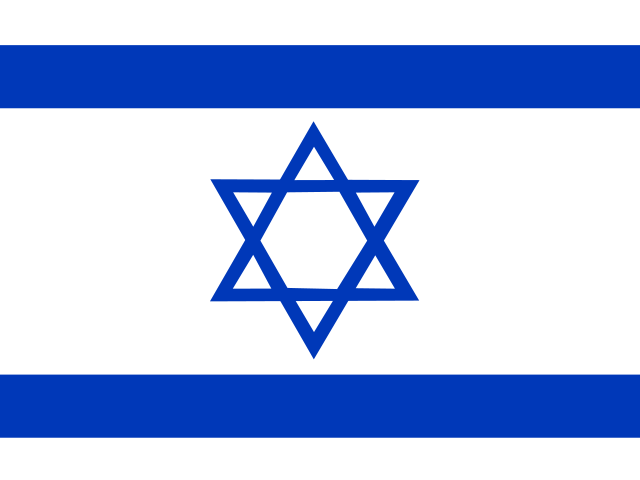
Israel overview
Israel lies in Western Asia, part of Asia. Treaties and official documents call it State of Israel. Government sits in Jerusalem.
The population is about 10.0 million, placing it 96th of 250 by population — between Azerbaijan above it and Hungary below. Measured only against its own subregion, it is 12th of 17 in size and 9th in population.
It covers 20,770 km², which ranks it 155th of the 250 countries and territories in this dataset — just behind El Salvador and just ahead of Slovenia. For scale, it is about two thirds the size of Belgium.
Israel and its neighbours, side by side
Israel has 5 land neighbours, and together they hold 163,859,008 people — about 16 times Israel's own population. Sharing a frontier with that much weight on the other side shapes trade, migration and language in ways the map alone does not show.
| Neighbour | Population | Area (km²) | vs Israel by area |
|---|---|---|---|
| Egypt | 116,538,258 | 1,002,450 | 48× larger |
| Syria | 24,672,760 | 185,180 | 8.9× larger |
| Jordan | 11,552,876 | 89,342 | 4.3× larger |
| Lebanon | 5,805,962 | 10,452 | 2.0× smaller |
| Palestine | 5,289,152 | 6,220 | 3.3× smaller |
By area the largest neighbour is Egypt and the smallest is Palestine; by population Egypt is the heaviest presence on the border. Taken together the neighbours hold more people than Israel does, which is the usual situation for a country with several borders and rarely a comfortable one.
Israel at a glance
- Capital
- Jerusalem
- Population
- 9,974,400
- Area
- 20,770 km²
- Region
- Western Asia, Asia
- Languages
- Arabic, Hebrew
- Currency
- Israeli new shekel (ILS)
- Calling code
- +972
- Internet TLD
- .il
- People per km²
- 480
Israel on the map
Its reference point sits at 31.5° north and 35.1° east, which puts it in the northern hemisphere, roughly 3,503 km from the equator, in what geographers would call subtropical latitudes.
Countries on the same parallel, far away in longitude, include Morocco and Bermuda.
Its land neighbours number 5: Egypt, Jordan, Lebanon, Palestine and Syria. The largest of them by area is Egypt, which is also the most populous. Together those neighbours hold about 163.9 million people.
With both a coast and land borders, it has the trade options a landlocked country does not.
Where Israel is on the map
The map below is centred on Israel at roughly 31.47°, 35.13°. Pan and zoom to see how it sits against its surroundings — the shape of a country's borders explains a surprising amount about its history.
Map data © OpenStreetMap contributors
Who lives in Israel
Density comes out at around 480 people per square kilometre, which makes it densely populated. The median across all 250 entries here is about 90 per square kilometre.
It recognises 2 languages: Arabic and Hebrew. Hebrew is listed for no other entry in this dataset, which makes it effectively unique to Israel. Arabic, the first listed, is shared with 24 other entries worldwide.
Someone from Israel is an Israeli.
Against Asia as a whole it is the 31st most populous of 50 entries, and it accounts for 3.2% of everyone living in Western Asia.
Israel within Western Asia
Zoom in from the world to Western Asia and Israel sits 9th of 17 by population and 12th by area. Its immediate company in that ordering is Azerbaijan just above and Lebanon just below, which is a more honest comparison set than a global league table.
Türkiye is the largest of the group by population, and every entry in Western Asia has its own page here if you want to work through the whole neighbourhood rather than one country at a time.
Money and language in Israel
Israel does not have the Israeli new shekel to itself. It is one of 2 entries on this site that use the currency, whose code is ILS, and the other one is listed below. A shared currency usually points at something real — a monetary union, a currency board, a former colonial administration, or a small economy pegging itself to a large neighbour's money — and it means a price quoted in ILS travels further than you might expect.
Language reaches wider still. Arabic is listed for 25 entries here, Israel among them, so a visitor who speaks it can be understood across a large part of the map. Shared language tends to outlive the empires, trade routes and migrations that spread it, which is why the linguistic map and the political one rarely line up.
Also uses the Israeli new shekel (ILS):
How big is Israel, really?
Put next to every other entry on this site, Israel ranks 155th of 250 by area and 96th by population. That works out at 0.014% of the combined land area of all 250 entries and 0.12% of their combined population. Those denominators matter: this list includes territories and dependencies as well as UN member states, so a rank here is not the same as a rank among sovereign countries.
For a sense of scale, the entries immediately either side of Israel in the size ordering are El Salvador at 21,041 km² and Slovenia at 20,273 km², against Israel's 20,770 km². If you can already picture one of those, you can picture this one.
Density tells a different story from either raw figure. Israel averages 480 people per square kilometre of total area, which makes it densely settled by global standards — 29th of the 248 entries that have both a population and a measured area. Total area includes inland water, so the true figure for habitable land is higher than this.
The practical details for Israel
The currency is the Israeli new shekel (₪, ILS). No other entry in this dataset uses it, so the currency is specific to Israel.
Its internet country code is .il. Calls from overseas start with +972. Standard country codes: il and ISR.
Jerusalem is the seat of government and the answer most quizzes are looking for.
It holds a seat at the United Nations, one of 193 entries here that do. The other 57 entries are territories, dependencies or observers, which is why totals on this site run to 250 rather than the familiar 195.
Fun facts about Israel
- Hebrew is listed as an official language for no other entry in this dataset.
- Within Western Asia it is the 12th largest of 17.
- Websites based there use the .il domain.
- Its capital city is Jerusalem.
- It lies about 3,503 km from the equator, in subtropical latitudes.
- Arabic is official here and in 24 other entries worldwide.
- It is 96th of 250 by population, with about 10.0 million residents.
- Its full official name is State of Israel.
Israel — frequently asked questions
- What is the capital of Israel?
- The capital of Israel is Jerusalem.
- Where is Israel located?
- Israel is in Western Asia, part of Asia. Its reference coordinates are 31.5° north and 35.1° east, roughly 3,503 km from the equator in subtropical latitudes.
- Which countries border Israel?
- Israel borders 5 countries: Egypt, Jordan, Lebanon, Palestine and Syria. Egypt is the largest of them by area.
- What language is spoken in Israel?
- Israel lists 2 official languages: Arabic and Hebrew. Hebrew does not appear as an official language anywhere else in this dataset.
- Is Israel a country?
- Yes. Israel is a sovereign state and one of the 193 UN members listed on this site.
- What currency does Israel use?
- Israel uses the Israeli new shekel, written ₪ (currency code ILS). No other entry in this dataset uses it.
- What is the population of Israel?
- Israel has a population of about 10.0 million, which makes it the 96th most populous of the 250 countries and territories listed on this site. Azerbaijan sits just above it and Hungary just below.
- How big is Israel?
- Israel covers 20,770 km², ranking 155th of 250 by land area. That makes it about two thirds the size of Belgium.