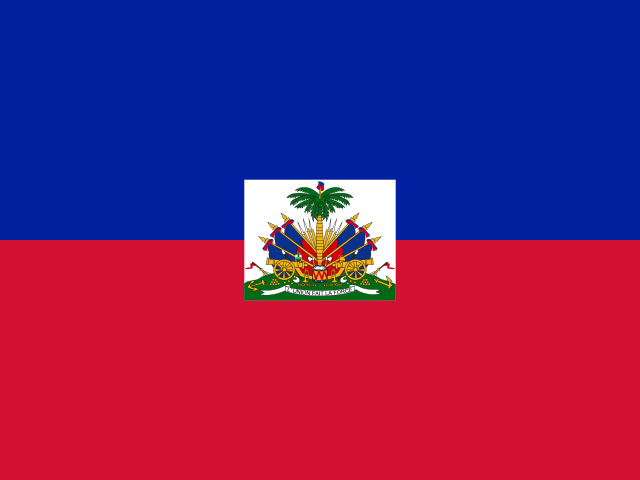
Haiti overview
Haiti is a country in the Caribbean, one of the 28 entries this site files under that subregion. In formal use it is Republic of Haiti. The capital is Port-au-Prince.
Some 11.8 million people call it home, placing it 83rd of 250 by population — between Belgium above it and Jordan below. Among the 28 entries in the Caribbean it ranks 3rd by area and 1st by population.
Its territory runs to 27,750 km², which ranks it 149th of the 250 countries and territories in this dataset — just behind Burundi and just ahead of Rwanda. Put next to a country most people can picture, it is a fraction smaller than Belgium.
Where Haiti is and what surrounds it
Plotted on a globe it falls at 19.0° north, 72.4° west, which puts it in the northern hemisphere, roughly 2,115 km from the equator, in what geographers would call tropical latitudes.
Follow that same latitude east or west and you reach India, Mali and Mauritania — places that share its distance from the equator but little else.
Its land neighbours number 1: the Dominican Republic.
It has both a coastline and land borders, which is the most common arrangement of all.
Where Haiti is on the map
The map below is centred on Haiti at roughly 19.00°, -72.42°. Pan and zoom to see how it sits against its surroundings — the shape of a country's borders explains a surprising amount about its history.
Map data © OpenStreetMap contributors
Countries bordering Haiti
Haiti shares a land border with 1 country: Dominican Republic. Each one has its own guide here.
Haiti at a glance
- Capital
- Port-au-Prince
- Population
- 11,772,557
- Area
- 27,750 km²
- Region
- Caribbean, Americas
- Languages
- French, Haitian Creole
- Currency
- Haitian gourde (HTG)
- Calling code
- +509
- Internet TLD
- .ht
- People per km²
- 424
People, population and language
Spread across 27,750 km², that works out at about 424 people per square kilometre, which makes it densely populated. Half the entries in this dataset fall below roughly 90 per square kilometre.
2 languages carry official status: French and Haitian Creole. Haitian Creole is listed for no other entry in this dataset, which makes it effectively unique to Haiti. French, the first listed, is shared with 45 other entries worldwide.
People from Haiti are called Haitians.
Inside the Americas it places 13th of 56 by population, and it accounts for 27% of everyone living in the Caribbean.
How big is Haiti, really?
Put next to every other entry on this site, Haiti ranks 149th of 250 by area and 83rd by population. That works out at 0.018% of the combined land area of all 250 entries and 0.14% of their combined population. Those denominators matter: this list includes territories and dependencies as well as UN member states, so a rank here is not the same as a rank among sovereign countries.
For a sense of scale, the entries immediately either side of Haiti in the size ordering are Burundi at 27,834 km² and Rwanda at 26,338 km², against Haiti's 27,750 km². If you can already picture one of those, you can picture this one.
Density tells a different story from either raw figure. Haiti averages 424 people per square kilometre of total area, which makes it densely settled by global standards — 33rd of the 248 entries that have both a population and a measured area. Total area includes inland water, so the true figure for habitable land is higher than this.
Haiti within Caribbean
Within Caribbean, Haiti is the most populous of the 28 entries this site lists, and 3rd by area. Dominican Republic is next in line by population.
Every entry in Caribbean has its own guide here, so if you want to work through the whole neighbourhood rather than one country at a time, Dominican Republic is the place to carry on.
Money and language in Haiti
The Haitian gourde (HTG) is used only in Haiti among the 250 entries on this site. Its own currency is one of the clearest markers of an economy that sets its own monetary policy rather than importing somebody else's.
Language reaches wider still. French is listed for 46 entries here, Haiti among them, so a visitor who speaks it can be understood across a large part of the map. Shared language tends to outlive the empires, trade routes and migrations that spread it, which is why the linguistic map and the political one rarely line up.
Currency and codes
It uses the Haitian gourde (G, HTG). It is issued for Haiti alone.
The top-level domain is .ht. To phone it from abroad you dial +509. Its ISO codes are ht and HTI, which is what most databases and flag files use.
If a quiz asks for the capital of Haiti, the answer is Port-au-Prince.
It holds a seat at the United Nations, one of 193 entries here that do. The other 57 entries are territories, dependencies or observers, which is why totals on this site run to 250 rather than the familiar 195.
Haiti codes and abbreviations
Every country carries a small set of codes that quietly run the practical world — phone networks, web addresses, passports, luggage tags and dropdown menus. Here are Haiti's, and what each one is actually for.
- Calling code+509
- Dial +509 after your international access code to reach a number in Haiti.
- Internet domain.ht
- .ht is the country-code top-level domain, so a web address ending in it is registered to Haiti.
- ISO two-letter codeht
- Used on vehicle plates, in currency pairs and in almost every dropdown list of countries.
- ISO three-letter codeHTI
- The form you will see on passports, at airports and in sports scoreboards.
- DemonymHaitian
- The correct word for a person from Haiti, and for the adjective form.
Fun facts about Haiti
- Ranked by land area, Haiti is 149th out of the 250 countries and territories on this site.
- In land area it is a fraction smaller than Belgium.
- Haitian Creole is listed as an official language for no other entry in this dataset.
- French is official here and in 45 other entries worldwide.
- India and Mali sit at almost the same latitude, on the far side of the globe.
- It is 83rd of 250 by population, with about 11.8 million residents.
Haiti — frequently asked questions
- What is the capital of Haiti?
- The capital of Haiti is Port-au-Prince.
- What is the population of Haiti?
- Haiti has a population of about 11.8 million, which makes it the 83rd most populous of the 250 countries and territories listed on this site. Belgium sits just above it and Jordan just below.
- Which countries border Haiti?
- Haiti borders 1 country: the Dominican Republic.
- What currency does Haiti use?
- Haiti uses the Haitian gourde, written G (currency code HTG). No other entry in this dataset uses it.
- What language is spoken in Haiti?
- Haiti lists 2 official languages: French and Haitian Creole. Haitian Creole does not appear as an official language anywhere else in this dataset.
- Where is Haiti located?
- Haiti is in the Caribbean, part of the Americas. Its reference coordinates are 19.0° north and 72.4° west, roughly 2,115 km from the equator in tropical latitudes.
- How big is Haiti?
- Haiti covers 27,750 km², ranking 149th of 250 by land area. That makes it a fraction smaller than Belgium.
- Is Haiti a country?
- Yes. Haiti is a sovereign state and one of the 193 UN members listed on this site.


