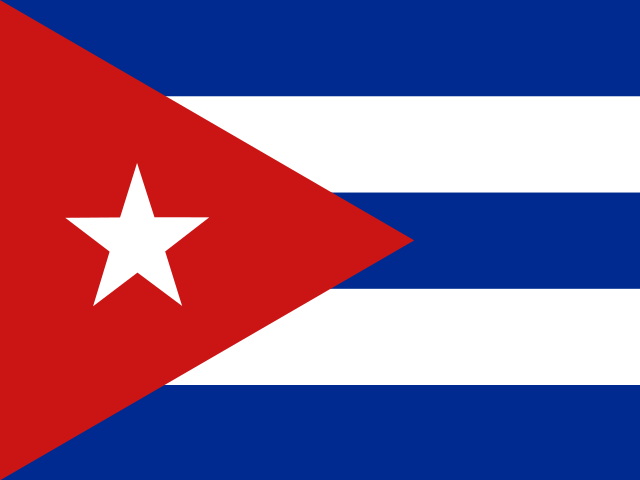
Cuba is a sovereign country in the Caribbean, in the wider region of the Americas. In formal use it is Republic of Cuba. The capital is Havana.
Some 11.0 million people call it home, placing it 87th of 250 by population — between the United Arab Emirates above it and Czechia below. Measured only against its own subregion, it is 1st of 28 in size and 3rd in population.
Its territory runs to 109,884 km², which ranks it 107th of the 250 countries and territories in this dataset — just behind Bulgaria and just ahead of Guatemala. Put next to a country most people can picture, it is a little larger than Iceland.
Location, borders and position
The coordinates the dataset gives are 21.5° N, 80.0° W, which puts it in the northern hemisphere, roughly 2,393 km from the equator, in what geographers would call tropical latitudes.
India, Mauritania and Myanmar sit at almost exactly the same latitude on other parts of the globe.
There is no land frontier at all — every boundary it has is a coastline. That puts it among the 85 entries of 250 here with no land neighbours, which shapes how it trades and who it deals with.
Map data © OpenStreetMap contributors
People, population and language
Density comes out at around 100 people per square kilometre, which makes it more crowded than the typical entry on this list. For comparison, the median entry on this list sits near 90 per square kilometre.
Officially it is monolingual: Spanish. Spanish is one of the widely shared official languages here, listed by 23 other entries including Argentina, Belize, Bolivia and Chile.
The demonym is Cuban, so residents are Cubans.
Inside the Americas it places 15th of 56 by population, and it accounts for 25% of everyone living in the Caribbean.
Currency and codes
More than one currency circulates: Cuban convertible peso (CUC) and Cuban peso (CUP). It is issued for Cuba alone.
Havana is the city to remember for this country.
Its internet country code is .cu. To phone it from abroad you dial +53. In ISO terms it is cu in two letters and CUB in three.
As a sovereign state it is among the 193 UN members listed here. The other 57 entries are territories, dependencies or observers, which is why totals on this site run to 250 rather than the familiar 195.
Fun facts about Cuba
- Websites based there use the .cu domain.
- In land area it is a little larger than Iceland.
- Spanish is official here and in 23 other entries worldwide.
- Within the Caribbean it is the 1st largest of 28.
- It lies about 2,393 km from the equator, in tropical latitudes.
- The Cuban convertible peso is used here and nowhere else on this list.
- Its full official name is Republic of Cuba.
Cuba — frequently asked questions
- What is the capital of Cuba?
- The capital of Cuba is Havana.
- What is the population of Cuba?
- Cuba has a population of about 11.0 million, which makes it the 87th most populous of the 250 countries and territories listed on this site. The United Arab Emirates sits just above it and Czechia just below.
- What language is spoken in Cuba?
- The official language of Cuba is Spanish. It is also official in 23 other entries on this list.
- What currency does Cuba use?
- Cuba uses the Cuban convertible peso, written $ (currency code CUC). No other entry in this dataset uses it.
- How big is Cuba?
- Cuba covers 109,884 km², ranking 107th of 250 by land area. That makes it a little larger than Iceland.
- Does Cuba border any other country?
- No. Cuba has no land border with any other country, so every route in or out is by sea or air. 85 of the 250 entries on this site are in the same position.
- Where is Cuba located?
- Cuba is in the Caribbean, part of the Americas. Its reference coordinates are 21.5° north and 80.0° west, roughly 2,393 km from the equator in tropical latitudes.
- Is Cuba a country?
- Yes. Cuba is a sovereign state and one of the 193 UN members listed on this site.


